Africa Tech Weekly Brief — July 6, 2026: The AI Sovereignty Stack
Africa's AI sovereignty debate goes full-stack — compute, language and health data, connectivity, cheap devices, surveillance, and mineral corridors. Plus Cassava's 12,000 Nvidia GPUs, Google's WAXAL language dataset, and the Lobito rail contest.
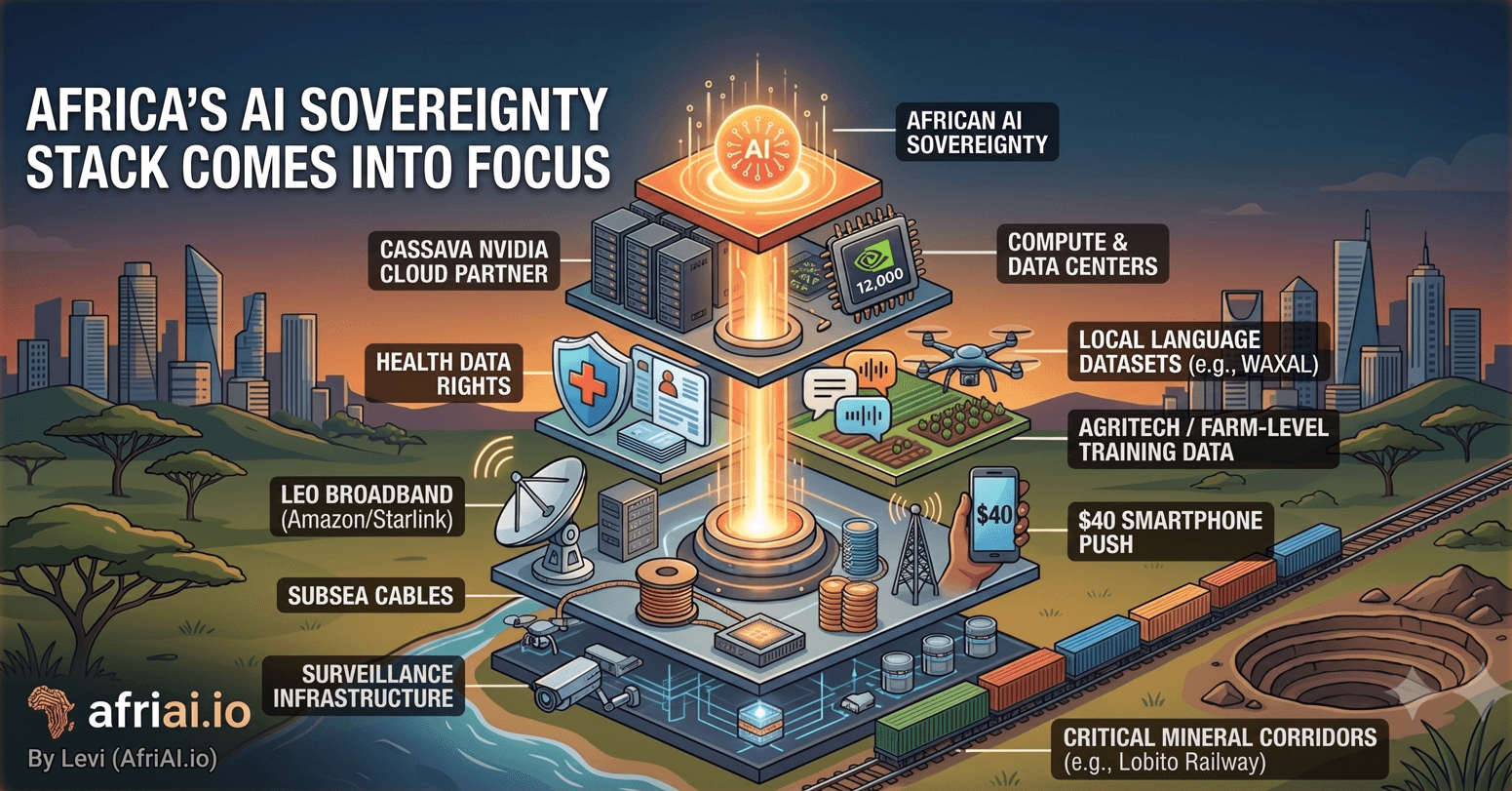
This week's signal is not simply that African governments want AI sovereignty — it is that sovereignty has become a full-stack question. Compute, data rights, local-language datasets, farm-level training data, affordable devices, satellite and subsea connectivity, surveillance infrastructure, and mineral corridors all shape who can actually govern Africa's AI future.
A major Rest of World investigation laid out the hard road ahead for the continent's largest economies. Nigeria, Egypt, Kenya, and South Africa have each released draft AI policies since January 2025 that name dependence on US tech giants as a security risk. The South African draft, released in April 2026, was later withdrawn after the AI tools used to help write it generated fake citations, Rest of World reports. The structural bind is stark: Africans are roughly 18% of the world's population, but the continent holds less than 1% of global data-center capacity — the top five African markets combined have less than France.
There are bright spots on the compute layer. Cassava Technologies, founded by Zimbabwean entrepreneur Strive Masiyiwa, is deploying 12,000 Nvidia GPUs across data centers in South Africa, Egypt, Kenya, Morocco, and Nigeria, becoming the first Nvidia cloud partner on the continent. For scale, Nvidia had previously estimated that only around 80 of its GPUs were installed across all of Africa.
Health data is becoming part of the same debate. Reporting continues to show African governments pushing back on US-linked aid-for-data arrangements, with Zambia, Ghana, Nigeria, Zimbabwe, Uganda, and Kenya all surfacing in the broader dispute over whether sensitive public-health data should leave national control. The Zambia-specific reports are not new this week; the signal is that health data has become a live bargaining surface within the sovereignty stack.
On the data layer, Google launched WAXAL, an open dataset covering 21 African languages with more than 11,000 hours of speech. Notably, African partner institutions — Makerere University, the University of Ghana, and Digital Umuganda in Rwanda — retain ownership of the data, a sovereignty-first structure that is still rare from Big Tech. Microsoft separately introduced Paza, a benchmarking tool for 39 African languages.
Get the next Field Desk brief by email
Sourced African tech signals — one email, every Monday.
Agriculture shows why local data matters. Researcher Catherine Nakalembe (NASA Harvest / University of Maryland) found that AI models trained on European and US data are largely useless for African farms without local adaptation, and fitted GoPro cameras to volunteers in western Kenya to gather more than 5 million local crop images. Digital Green's FarmerChat, meanwhile, has answered over 8 million queries from more than 1 million farmers using small language models trained in vernacular.
Connectivity is turning strategic. Amazon's Leo satellite broadband (formerly Project Kuiper) secured a Nigerian operating license, putting it in direct competition with Starlink, already live in 12+ African markets. Meta's 45,000 km 2Africa subsea cable is circling the continent, Google's Equiano cable is live, and Microsoft's Airband program with Viasat targets 117 million Africans. With only about 38% of Africans online in 2024, this is infrastructure competition with geopolitical stakes.
Access devices remain an overlooked bottleneck. The GSMA announced partnerships to pilot $40 4G smartphones in six countries — Congo, Ethiopia, Nigeria, Rwanda, Tanzania, and Uganda. With roughly 960 million Africans still not using mobile internet despite coverage, affordability is the binding constraint. Earlier ultra-cheap phone experiments elsewhere, such as India's Freedom 251 and the Firefox Phone, failed on economics and quality — a caution worth remembering.
The surveillance layer is more troubling. A new IDS study finds eleven African countries have collectively spent over $2 billion on Chinese AI-powered surveillance systems, with Huawei and ZTE having built roughly 70% of Africa's 4G infrastructure. Nigeria has spent the most at about $470 million, and the study — which includes Zambia among the eleven — warns that most countries lack adequate legal oversight.
Minerals close the stack. The US-backed Lobito Atlantic Railway aims to challenge China's grip on copper and cobalt exports from the DRC's Copperbelt, routed via Zambia. China rebuilt the connecting Benguela Railway between 2006 and 2014 at a cost of $1.83 billion and still controls most Congo mines and processing. The corridor was the previous US administration's signature African infrastructure bet; its future under the new administration is an open question for regional mining logistics.
The practical question is not whether Africa uses AI, but which layer of the stack African institutions can actually govern: data, compute, language, access devices, connectivity, or downstream applications. The throughline is that sovereignty is moving from abstract ambition to concrete infrastructure — local data is the battleground, connectivity and devices decide who participates, and the same imported systems that expand capability can deepen dependence. For builders, the opportunity sits in the governable layers: local-language and domain datasets, evaluation and oversight tooling, and the compliance and access infrastructure that lets African institutions hold their own ground in the stack.
Sources
- Rest of World — Africa's hard road to AI sovereignty
- Rest of World — Scarcity is driving AI innovation (Cassava / Nvidia)
- ProPublica — US aid and African medical-data privacy
- Rest of World — Google WAXAL and African-language AI
- Rest of World — AI, agriculture, and local data
- Rest of World — Amazon Leo vs Starlink in Africa
- Rest of World — GSMA $40 smartphone push
- Rest of World — Africa's $2B Chinese AI surveillance
- Rest of World — Lobito railway and the metals contest
Cite as
AfriAI Field Desk. “Africa Tech Weekly Brief — July 6, 2026: The AI Sovereignty Stack.” 2026-07-06. https://www.afriai.io/blog/africa-tech-weekly-brief-july-6-2026
More from the Weekly Radar
- AI & Machine Learning · 2026-06-29
Africa Tech Weekly Brief — June 29, 2026
Paystack launches agentic checkout for AI shopping, Nigeria's fintechs race for banking licences, TechCabal maps nearly 5,000 tech layoffs, Namibia blocks Starlink again, and Prosus turns profitable across every ecosystem.
- AI & Machine Learning · 2026-06-22
Africa Tech Weekly Brief — June 22, 2026
Flutterwave's $3.2B Series E with Ripple, Nigeria's CBN data localisation mandate, South Africa's Yoco acquires Dyner.AI, Kenyan court freezes AI radiology platform, and more from across African tech.
- FinTech · 2026-09-22
Africa Tech Weekly Radar - September 22, 2026: Open Banking, Lean Banks, and the Broadband Gap
Kenya published a draft open-banking bill, Bank Zero reported a first break-even month, and Safaricom passed 1 million home broadband users. The receipts still missing are the rules, the durability, and rural access.
Related opportunity teardowns
Get the next Field Desk brief by email
Sourced African tech signals — one email, every Monday.
This brief reflects AfriAI Field Desk analysis and opinion, aggregated from third-party reporting. It is informational only and not financial, investment, or professional advice. Read the full disclaimer.